

Data isn't sexy anymore
Turns out nothing kills the sex appeal quite like watching tech overlords ruin people's lives for profit.

In October 2012, Harvard Business Review published what would become one of the most quoted headlines in tech: “Data Scientist: The Sexiest Job of the 21st Century.” At the time, companies were wrestling with unprecedented volumes of data and demand for analysts was well ahead of the supply. “Data Scientists” were the people with the technical skills to find the story buried in masses of unstructured data and package it into a compelling story to be sent back to stakeholders.
In 2021, fresh out of a neuroscience degree and having absolutely no idea what to do with it, I called my dad and announced (with only the kind of certainty a 24-year-old can muster) that I was going to be a data scientist. There will always be data and someone will always have to analyse it, right?
And during this period, I benefited heavily from the mass hiring of data and tech jobs that happened around 2020-2022. I also started Style Analytics around this time — when data about fashion was (1) accessible enough for me to use and (2) people were interested in the sparkle of “objectivity” that came about from looking at fashion through data.
This was a time when the data won almost every argument. In my first job as a data analyst in an advertising agency, every decision and direction proposed to a client needed to be justified with some sort of data point. And with Style Analytics, data driven trends (my forte at the time) offered the “truth” in a landscape of TikTok fashion trend forecasters predicting 1000 trends per season.
However: in the past year, I have observed that confidence in data deteriorate. Data no longer won every client versus agency stand-off and data-driven trend forecasting doesn’t have the same appeal that it did in the beginning. (That type of video (1) started performing poorly and (2) could often be just one trend in a sea of ever-growing pinterest and google growth metrics being reported on social media and (3) these videos were often met with “wow thanks for telling me the trend - now I know what not to wear”.)
And with that — I started to think about why data has lost its appeal in online discourse/culture and with clients in creative industries (the two spaces I can speak to — you can let me know if you have experienced anything similar in your field).
#1 Data was never objective (but we thought that it was).
As I said above, data used to have that sparkle of objectivity — but those in the industry knew was not true. The result of your analysis was always dependent on how you chose to measure, who you chose to measure, and the research questions you were trying to answer going into. Results had to be cared for in order to approximate reality. And of course, manipulations or ill intentions could leave us with untrue and inaccurate results (just look at the replication crisis in psychology). But this was a small enough problem. When I read a stat or metric in some article or research report from a credible enough souce, I genuinely took it with the truth — leaning on the assumption that every researcher reporting their findings was doing their absolute best to be objective.
In my opinion, AI has accelerated a lot of the existing problems with data and research. Now, with the help of AI, anyone can generate a stat, surface a study, or build a chart in minutes that supports whatever they already believe. The amount of times I would ask a colleague (not at my current job and usually not in the data/insights department) where a statistic came from that was the framed as a critical point in a strategic deck and they would say “oh I used Perplexity to prove X” — you would be shocked! But that only works for so long before clients (and more broadly, everyone interacting with research online) realises that you can surface a stat for just about anything, and therefor including data loses a lot of its value.
#2 Taste has become the scarce resource that data used to be.
With so much data available, and data informing nearly every decision, we've grown fatigued with the idea that everything needs to be data-backed. At the same time, taste discourse has been raging online — that in an age where AI can produce the median data-backed answer in seconds, a genuine point of view is the one thing that can't be replicated.

As Amy Francombe writes in her article “taste is when a brand resists market dynamics” That distinction is important because people now confuse taste with data science. A huge portion of mainstream culture has been built by people who are extremely good at reading metrics like Instagram engagement, SEO traffic, box office figures, audience retention curves, watch time, click through rates, etc. They are effectively predictive analysts, and are identifying inflection points before everyone else does. They know when hemlines are coming back and when audiences are fatigued by minimalism and ready for excess. But they don’t necessarily know how to answer the more difficult question underneath it all: is something actually any good?
For a brief moment there, having a decision be data-backed (either in creative industries or to just tell you what is “trending”) held a lot of weight. Now, I'd argue, the currency has shifted: the buzziest way to land an idea is to frame it as taste, either by having it yourself or by invoking someone who does.
Part of the reason that taste can win over data in online/creative discourse/conversation is that when left to its own conclusions, data tends toward the obvious. Like with using search volume for trend forecasting: by definition, the results with the highest numbers are the things everyone already knows about. It tells you what is popular right now — not why it became popular, not what it means, and not what comes next. The more you optimise for volume, the more generic the output. An over-reliance on data-driven creative decisions has left us with increasingly bland, middling output. Taste is the antidote here.
(They can of course be complimentary and build off each other, with data coming first and taste stepping in when data-driven insight has reached its limits.)
Argument 3: Data as a catalyst of physical harm.
Back in 2021, I co-wrote a report on how our online activities contribute to climate change. (It is actually a pretty easy introduction to data centers if you are new to the topic.) This was pre-AI, where your online activities appeared to exist in a vacuum. Where and how was your online data stored? The cloud (sexy, sleek). And this report we attempted to shed a light on that, covering calculations (probably inaccurate by now) on how different online activities contributed to climate change based on their data center and resource use.
In the report I wrote the line: Enter a new era of digital ethics: one focused on tech sustainability, and the realisation that digital activities have a real carbon cost. And with that — I should have any credibility on trend forecasting striped from my name. (I am joking, the cultural and fashion trend predictions have been a bit more accurate.) Obviously, I wasn’t expecting the mass expansion of data centers to accommodate for our AI usage only 4 years later.
Data centers consume enormous quantities of water for cooling and electricity to run, often in regions already under resource pressure. And in the US, as you have probably seen in TikTok clips, data centers ruin the lives of residents who happen to live near them — paying double their typical electricity bill to accommodate for the extra grid pressure, polluting their water, and having noise pollution 24/7. Kevin O’Leary’s proposed data center in Utah is playing out in a very dystopian way — with local governments ignoring the pleas of their constituents and in favor of corporations trying to take advantage of them. Turns out nothing kills the sex appeal quite like watching tech overlords ruin people's lives for profit.
(That said, not all data analytics is equal here. Running code locally in Excel, R Studio, or Anaconda (offline, self-contained) relatively lower impact compared to AI models extracting and analysing mass amounts of data at scale. Perhaps I revisit my sustainable digital design report methodology to provide an actual calculation.)
Conclusions
Data obviously still sits at the centre of how governments, organisations, and researchers make decisions. What has changed is the cultural authority of stats and metrics, particularly in creative fields and on social media, where the conditions that made data feel authoritative have deteriorated.
While "data-backed" may have lost its sex appeal, there are still real ways to mitigate the harms this article describes. Things we can do: source data carefully and only from reliable outlets, be transparent about your methodology when you're the one reporting a finding, take cues from the Open Science movement in academic research (honestly, could be a whole separate piece), and reduce reliance on AI both as a shortcut for proving a point in research and as a tool for analysing large datasets.
I recognise the irony of writing this having just published a piece last week about my own career in data. And I will continue with said career (of course) doing my best to report high quality, honest findings for both Style Analytics and my 9-5. I am also working on recognising the limitations of data and letting go of the idea that something being “data-backed” wins every argument.
Honestly upon re-reading the advice listed above perhaps this article is just a reminder to myself on how to ethically continue with both of my jobs. I hope you have also found it helpful <3 thanks for reading!
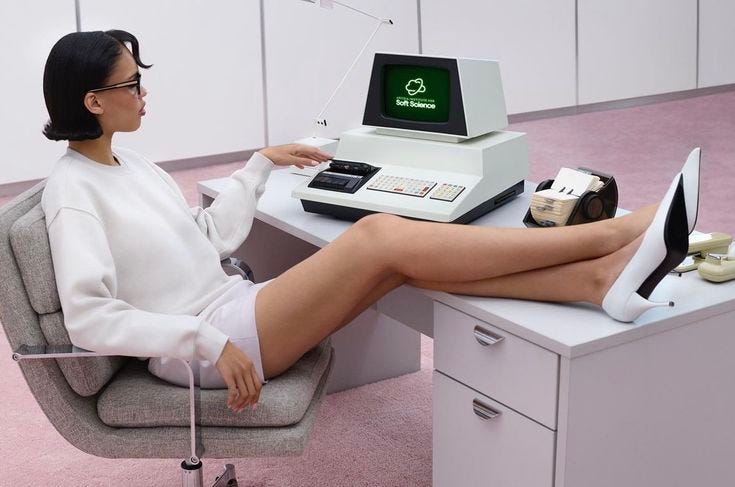
Nara Smith’s Aritzia campaign in 2024, probably one of the last being-on-your-laptop-is-sexy campaigns and editorials.
Being on your laptop? No longer cool and niche.
Having a laptop-free job? Something IRL? A job where you actually make something? Definitely cool and niche.
Straight to SAVE. Makes a lot sense!!!
This definitely reflects my experience, having just left Google. And tbh, as more of a qualie, it thrills me!